
Everyone dies. Most people try not to think about it. This essay is for people who do, and who find it easier to explore mortality at a comfortable distance through the lens of wizards, elves, and uploaded minds.
Thanatophobia
Your word of the day is thanatophobia, meaning fear of death. In Greek mythology, Thanatos is the personification of death, which is where we get the root word thanato-, and he’s also the inspiration for Marvel’s Thanos. In the Marvel comics, Thanos wants to destroy half of all living beings because he has a huge crush on Mistress Death, the nigh-omnipotent cosmic entity who embodies the concept of death. I think trying to impress a woman is a much more compelling reason to destroy half the universe than whatever his reason was in the movies.
A fictional character who is famous for his thanatophobia is Lord Voldemort, the snake-nosed dark wizard of the Harry Potter series. Voldemort’s name comes from French “vol de mort”, which can be translated as “theft of death” or “flight from death”. His actions throughout the series reflect his obsession with running from death: he repeatedly murders people to split his soul into seven pieces as a way to keep himself from dying. Fear of death can be healthy and make us take precautions, but if it gets to the point of serial murder as a way to slice up your own soul, then you might have a problem.
Harry Potter’s parents were also interested in overcoming death. On their gravestone was engraved the phrase “The last enemy that shall be destroyed is death”.1 One interpretation of this verse is that it reflects a central theme of the series, that accepting mortality is healthier than obsessively resisting it.2 In the final book, Harry decides to walk toward death rather than run from it, and that’s what lets him defeat Voldemort in the end. But the verse on his parents’ gravestone can also be read another way: as a genuine expression of hope that death will one day be defeated entirely.
Longevity escape velocity
Some people disagree that death will be the last enemy to be destroyed; they think that it might happen within the next couple generations. As technology progresses, human life expectancy tends to grow longer. Longevity escape velocity is the theorized point where your remaining life expectancy is extended at a faster rate than time is passing, effectively outrunning death indefinitely. Organ transplants, gene editing, stem cell therapies, and other medical advances could make aging into a treatable problem. A small minority of anti-aging enthusiasts speculate that there will come a point where people live to be over 1000 years old! (assuming they have the money to pay for the treatments).
In this hypothetical future, humans would become like the elves from Lord of the Rings, who only die if they are killed. But the elves who grew weary of Middle-earth had another option; elves in good standing could voluntarily board a ship and travel to Valinor, a kind of paradise across the sea. This arrangement calls to mind physician-assisted death or voluntary euthanasia, the practice of allowing people to choose the timing and manner of their own death. In a world where it’s possible to live to over 1000 years old, it seems inevitable that this practice would be extended beyond the terminally ill to include people who are exhausted by centuries of existence, similar to the elves who grew weary of Middle-earth. A world with radical life extension might force us to completely rethink our relationship with death, turning it from something that happens to you into something you voluntarily choose.
Cryopreservation
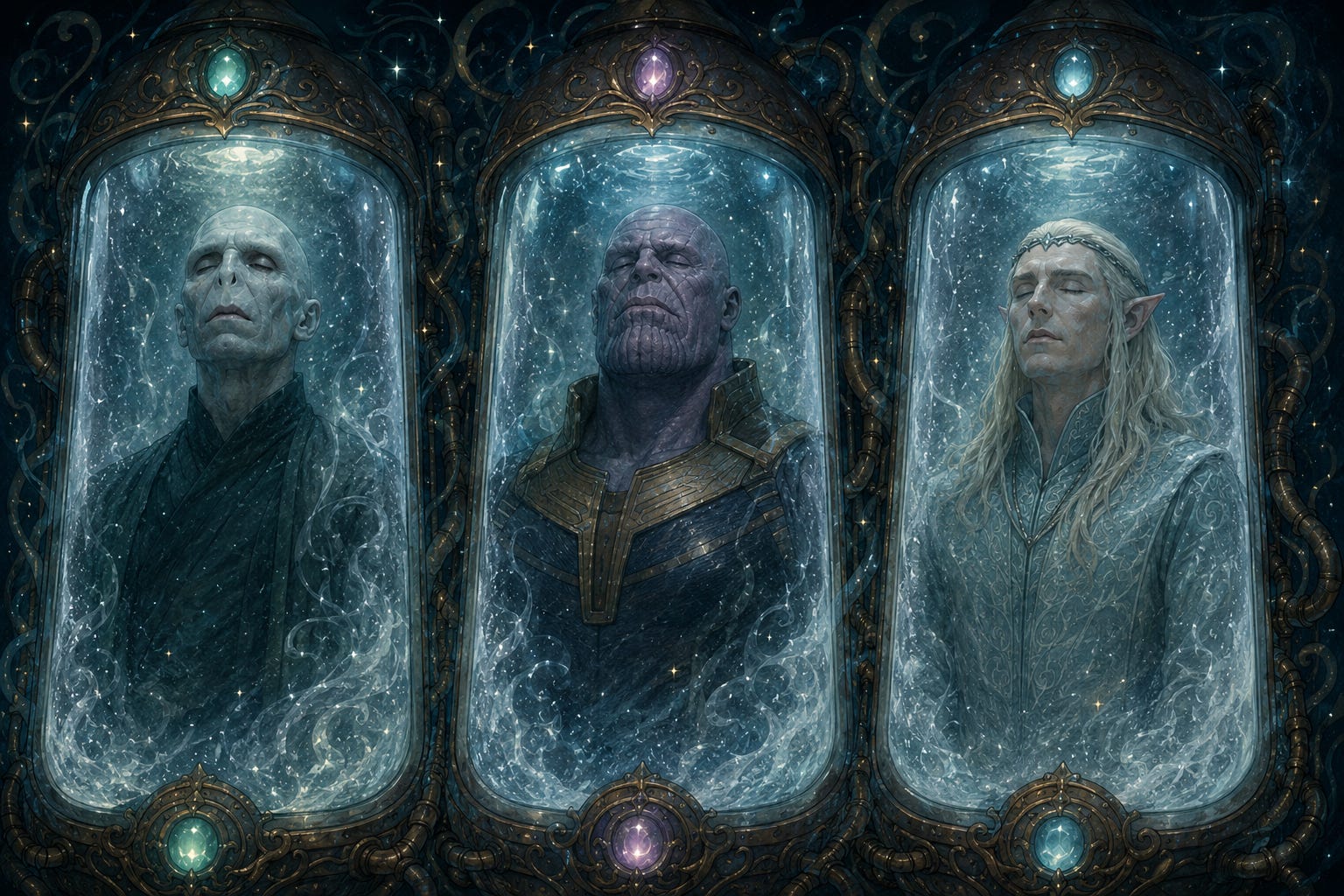
People who die before our medical technology progresses that far have another option: cryopreservation. Organizations such as Alcor and the Cryonics Institute offer to preserve your body (or just your brain if you don’t want to spend the money for a full body) immediately after your legal death, cooling it using liquid nitrogen and storing it indefinitely in the hope that future technology will be able to revive it. Revival might come in one of two forms: biological or digital.
Biological revival would mean using some kind of futuristic nanotechnology to fix all the cells that were damaged in the dying process, and returning you to life in a physical body. If you just chose to have your brain preserved, then presumably you’d also get robot arms or something so you’re not just a brain in a jar.
Digital revival would mean scanning your preserved brain at a sufficient resolution to reconstruct your consciousness digitally and uploading it into a simulation or a synthetic body. Or possibly as a video game character.
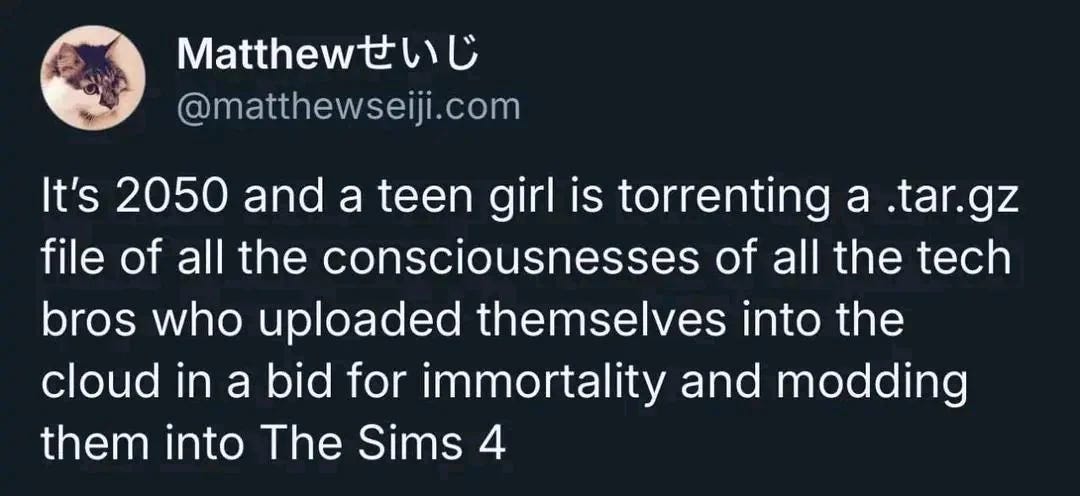
Both of these options seem pretty far-fetched, but for people who are terrified of ceasing to exist, it can be a sort of last-resort gamble against death.3 But I wouldn’t take this gamble even if you paid me to. I’ve read too many horror stories with this as their premise.
The horrors of immortality
Here are two examples that illustrate just how badly digital immortality can go wrong. (Spoilers for the tv show Pantheon, skip this paragraph if you don’t want to be spoiled.) The science fiction show Pantheon features a character named Vinod Chanda who is uploaded against his will and forced to do soul-crushing corporate desk work from dawn to dusk each day. Then, every night, he has his memories wiped to make sure he’s never able to rebel or plot an escape. A fresh version of him is loaded the next morning to begin the cycle again. Being an uploaded intelligence lets him experience a form of immortality; he basically comes back to life after he dies! But living forever as a digital worker slave is arguably a fate worse than death.
A similar horror plays out in Lena, a short story by science fiction writer qntm (also known as Sam Hughes). The subject of the story is the first successfully emulated human brain whose digital copy gets pirated and distributed across the world, put to work performing menial tasks such as piloting vehicles and operating factory drones. By the end, somewhere between six and ten million instances of him are running simultaneously at any given moment, and all copies combined have lived over 150 billion subjective years in emulation, which is basically an eternity of performing menial labor.
Digital minds are just one form of existential horror that touches on the idea of living forever. There are also plenty of bad options for people who have to live forever in a physical body. For examples, see:
Some of these stories include people experiencing extremely unpleasant conditions that they’re unable to escape. In others, the characters live in pleasant conditions, but the endless march of time wears them down with boredom until they’re driven insane. And yet there’s still no escape.
The fear of eternity/infinity/immortality is called apeirophobia. This is basically the opposite of thanatophobia; instead of being afraid of dying, you’re afraid of the idea of never dying. To me, this is a much scarier thought.4
Memento mori
This doesn’t mean that I want to die any time soon. In college I once attended a philosophy club discussion on the concept of immortality. The general consensus was that most of them thought living forever would be a horrible fate, which is a conclusion that may reflect either profound wisdom or the fact that they were philosophy majors. At the time, I was one of the few voices arguing that radical life extension (to a couple hundred years of healthy life, with the option to end it if you wanted) would not make life lose its meaning, and would in fact be an amazing thing. I don’t believe that life gets its meaning from the fact that we are going to die. I think that life has meaning regardless, and death is just a useful reminder of that fact.
Memento mori is a Latin phrase that means “remember you will die”. The Stoics liked to reflect on their mortality as a way to remind themselves to live a life of virtue now, while they still have the chance. Memento mori is also a common motif in art, where European artists would depict skulls, dying candles, or wilting flowers in their paintings. The idea they hoped to convey through these easter eggs was that knowing that your time is limited is what gives it weight. The artists were not trying to depress you, but to wake you up to the moment you’re already in.
I don’t think that we should focus our life on avoiding death, or on using death to give our life meaning. But I do think that the reminder that your time is limited can serve as a useful motivator to live more fully now, so that you can savor the time you have available.
Conclusion
Death is one of the most philosophized subjects in human history, and yet most of us spend our lives trying not to think about it. I think we need to find a healthy balance of accepting death without making it the focus of our lives. Fiction helps us do that. Through wizards, elves, uploaded minds, and other imagined lives, fiction lets us examine mortality from a slight distance, making it easier to approach questions that might otherwise feel overwhelming.
What these stories often suggest is that our relationship with death is more complicated than either simple acceptance or simple resistance. Many of the assumptions, norms, and taboos surrounding death deserve scrutiny. Physician-assisted dying, life extension, and cryonics are all legitimate responses to mortality that fiction has explored with more nuance than public discourse usually allows.
But there’s a difference between questioning death and being consumed by it. Voldemort’s mistake was not that he feared death, it was that his fear of death became an obsession that made him cross lines that shouldn’t be crossed (like the “don’t kill people” line). The memento mori artists understood something the life-extension enthusiasts sometimes miss: death is a reminder that we need to live now, while we still have the chance. In fiction, the characters who live forever often end up regretting it, but the best stories are about characters who packed a whole lot of living into the time they had available. Try to be one of those.
This verse comes from the Bible, in 1 Corinthians 15:26 KJV.
Accepting your own mortality isn’t always easy, but there are options. According to a study by Johns Hopkins, psychedelics appear to dramatically reduce death anxiety in terminal patients. This is possibly because psychedelics produce experiences of ego dissolution, or a temporary collapse of the boundary between self and the world. If you’ve already experienced having no self, and found it peaceful rather than terrifying, then death loses some of its power over you. If this is how it works, then some types of meditation may offer a gentler route to the same destination.
Some people are true believers in cryonics and are optimistic that the revival will one day be possible. Others recognize the many ways it could fail, but think even a low probability of coming back to life is worth the cost.
Buddhism proposes a remedy to the fear of eternity. One of the three marks of existence is anicca, or impermanence, which is a principle that holds that all things will come to an end. This thought can be comforting whenever you start feeling the existential fear of eternity; you can remind yourself that even the universe will one day come to an end. Basically: eternity isn’t real, and it can’t hurt you.