Functional fixedness and 2 liter soda bottles
Most people have a hard time seeing alternative uses for everyday objects due to a cognitive bias called "functional fixedness".

Here’s a brain teaser for you. On the table in front of you is a candle, a matchbook, and a box of thumbtacks. Using only these items, how do you fix the lit candle to the wall so that it won’t drip wax onto the table? If you want to think about it for yourself, pause for a minute before you continue reading. (You can look at the picture though.)
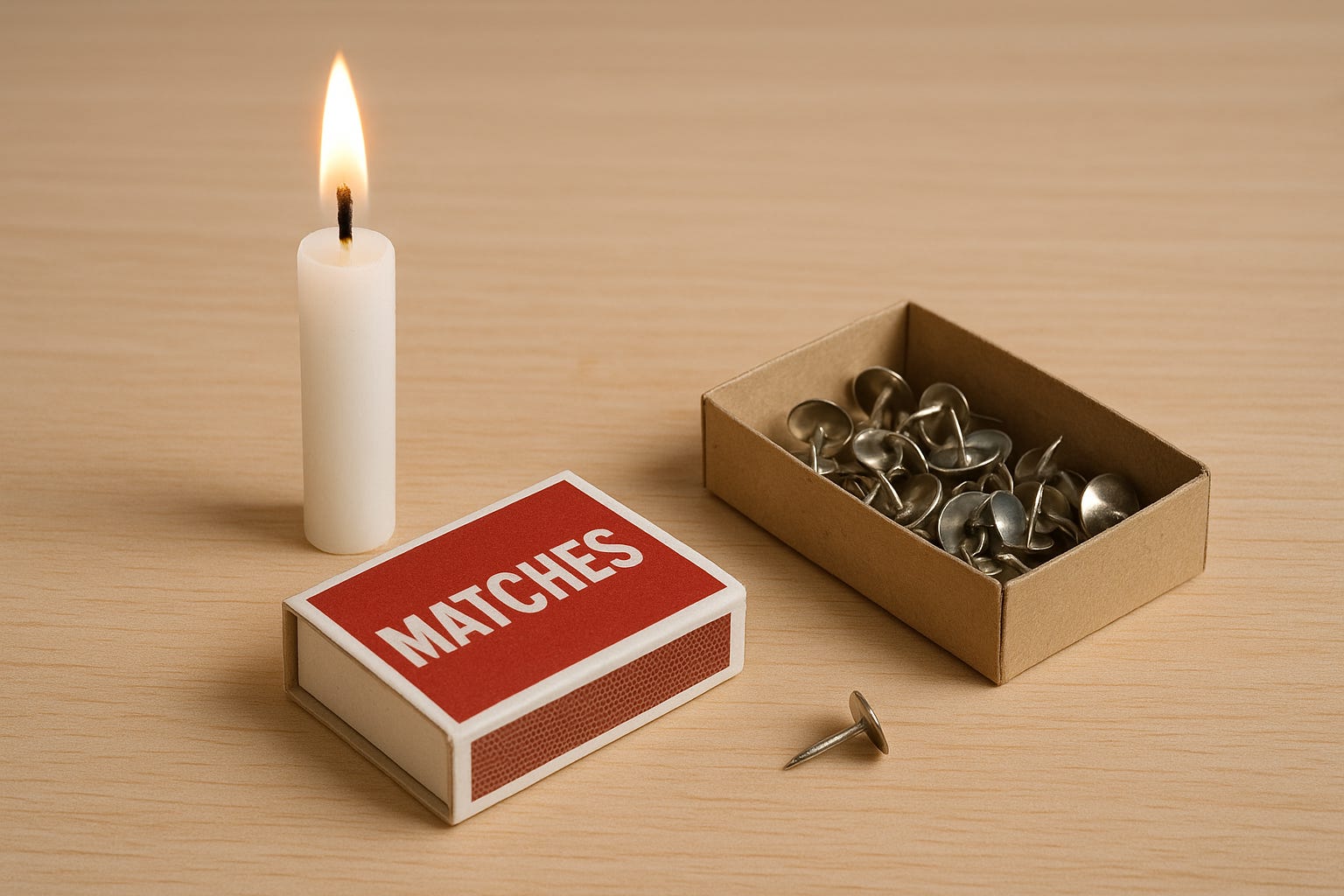
This puzzle is called Duncker’s candle problem, and it demonstrates the concept of functional fixedness.
Area you ready for the answer? 3… 2… 1… The easiest way to solve the problem is to empty the box of thumbtacks, use the thumbtacks to nail the box to the wall, and set the candle in the box. (I guess the matches are just in case the candle gets blown out.) In the original version of this problem, less than half of participants were able to solve it. This is because of a cognitive bias called functional fixedness, which is like a mental block that prevents us from using objects in ways they aren’t generally intended to be used. Most people have a hard time solving the candle task because we think of the box as only a way to hold the tacks, and not as a material we can use. When the task was changed so that the tacks were lying on the table next to the box, it removed this mental block and nearly 100% of participants were able to solve it. Today I want to talk about the idea of functional fixedness (including how it can sometimes be beneficial), and share some examples of people creatively getting around it.
Functional fixedness isn’t always a bad thing
Functional fixedness is when an object’s intended use (or function) becomes so fixed in our mind that we can’t see any other possible function for it. Sometimes this can be a good thing.
If you need to pound a nail, you usually use a hammer. But if you can’t find your hammer, what should you do?
Give up.
Look harder.
Buy a new hammer.
Use a rock, brick, wrench, flowerpot, or something else heavy to pound the nail in.
I would argue that number 4 is rarely the right answer. If you try to hammer a nail using a brick, then you’re way too likely to break the nail, the wall, or your finger. You generally want to use the right tool for the right job. Functional fixedness prevents you from seeing every brick as a potential hammer, and that’s probably a good thing.
Whenever I learn about a cognitive bias such as functional fixedness, I try to think about two things: 1. If the bias serves a useful purpose, and 2. What habits should I develop to help overcome it. As biases go, this one is pretty benign. It’s often helpful (by preventing you from using a flowerpot to hammer nails) and generally only hurts you when you’re trying to solve convoluted brain teaser problems. So let’s talk about when it makes sense to flex your creative muscles and use objects in nonstandard ways. I was able to identify five criteria:
Immediacy. When you need a solution now.
Low-cost. When you don’t want to spend resources on solving the problem, or when you don’t have any resources to spend.
Low-importance. When the consequences to getting it wrong are minor.
Temporary. When it isn’t something you’ll have to use for the rest of your life.
Reversible. When you can replace it with something better later on.
For something important, long-term, permanent, or safety related, you should generally use materials for their intended purposes instead of trying to get creative. It will often save time and money in the long run.
If you do want to overcome your functional fixedness so that you’re better at solving brain teasers like the candle task presented earlier, there are a few things I can think of that might help.
Practice viewing objects in terms of their fundamental properties (e.g., heavy, sharp, hollow, reflective) rather than their traditional functions.
Practice reframing problems. Restate your goal in different words. Instead of saying “I need to find my watering can”, say “I need a way to get water to these plants”. This can help you recognize that a mug or a soda bottle would work almost as well.
Temporarily relax your constraints. If you’re stuck on the candle problem, ask “if I had my choice of materials, how would I solve this problem?” When I do this, my first thought is that I could attach the candle to the wall using a piece of string. My second thought is that a piece of paper or cardboard would work just as well. That thought leads directly to finding the actual solution.
Apply your gorilla filters. In a previous post I wrote about looking at the world through different lenses to help us identify details we would have missed (such as invisible gorillas). For example, sometimes I ask myself what Sherlock Holmes would notice in this situation, and try to look through his eyes. I’d bet that doing something like this could also help you overcome functional fixedness.
Doing these types of things can also be good practice for creative thinking that helps you come up with new ideas and get better at solving problems. At least that’s what they tell me. I don’t know how well it actually works, but it seems reasonable that practicing creative thinking can make you more creative.
Functions of a 2 liter soda bottle
Now I’d like to share some examples of using an everyday item in nonstandard ways. The item I have in mind is a 2 liter soda bottle. The traditional use for a soda bottle is, you guessed it, storing soda. But there are many, many other ways it can be used.
When I lived in Mexico, one of the apartments I stayed in didn’t have a shower head. But one of the guys I was living with knew just how to solve this problem: he took an empty soda bottle, poked holes in the bottom, screwed the top into the shower pipe, and voilà! (except in Spanish), we had a shower head! It wasn’t very good, but it wasn’t awful either.
In a different city in Mexico, my apartment didn’t have a washing machine, and we had to wash our clothes by hand. But the person I was living with (different guy this time) took a 2 liter soda bottle, cut the end off, and used duct tape to attach a broom handle to make a sort of plunger. We used it to churn the clothes and loosen the dirt so we didn’t need to scrub them as much.
In addition to a shower head and a plunger, here are some other possible unconventional uses for a soda bottle:
Piggy bank
Bag dispenser
Science experiment to demonstrate the greenhouse effect
Bowling pins
Tornado-in-a-bottle science demonstration
Cloud-in-a-bottle science demonstration
Mini-greenhouse for growing plants
Funnel
Pet food scoop
Bird feeder
Watering can
As someone who likes recycling and creativity and doesn’t like spending money, I appreciate it when you can solve a problem using materials you already have instead of buying something new. We’re surrounded by a culture of consumerism that tells us that we need to buy more things, but really all we need is more 2 liter soda bottles.
Conclusion
Functional fixedness is a systematic error in our thinking that makes it hard to see alternative uses for an object, other than the purpose it was intended for. Sometimes this can be a good thing, because using objects for purposes they weren’t intended for is a great way to break things. But it can also limit our creativity. Thinking up interesting ways to use an everyday object, such as a 2 liter bottle of soda, can be fun, can reduce waste, and can save you money.
If there are safety issues, or if using a hacked together solution negatively affects your life, then I don’t recommend trying to get creative. For example, I do not recommend the soda bottle shower head as anything more than a temporary fix; it was not very good. But if you want to get better at solving puzzles like the candle problem, which require thinking outside the box and using materials in non-traditional ways, then you should probably start drinking a lot of soda. Those bottles can do so many things!
I like this thoughtful analysis, and I’m always interested in cognitive biases.
This one makes me think of HPMOR (if you’re familiar?), when Harry comes up with so many creative ways to kill an enemy using only the materials in the classroom.
Being from West Virginia, land of the “hillbillies,” I would guess that this is not a cognitive bias we struggle with as much as some others. People around here use things in all sorts of odd ways, out of necessity and general non-rigidity about how things are to be used. It’s more a mindset of “whatever works.” For example, my outside trash bins are actually metal burn barrels; my mother-in-law uses empty tissue boxes to hold odds and ends; and my friend uses a broken ladder as a chicken perch.