
I’ve been meaning to write about the skills I learned in grad school, but the inspiration to finally do it came from an unexpected place: professional sports. Top-tier athletes constantly study game footage, analyzing their own performances and those of elite competitors to identify areas they can improve. I recently read an article titled “Film study for research”, which suggests that we should take this same concept and use it to improve our research and problem-solving skills by observing top researchers in action. But how do you do film study for engineering research?
I went to grad school to study chemical engineering, which is a field that requires deep reasoning about physical reality and practical constraints. But, unlike athletic performance, this kind of thinking isn’t very spectator-friendly. You won’t find many YouTube videos of famous engineers solving problems. This is the same for most thinking fields; university professors and top scientists rarely document the specifics of their research process, making it difficult for most of us to observe how exceptional thinkers actually work.1 There's one major exception: PhD students interacting with their advisors. This type of mentorship is one of the rare opportunities for younger researchers to learn critical thinking and problem solving skills straight from some of the world’s top thinkers.
I’ve been reflecting on the once-in-a-lifetime opportunity I had to interact regularly with my PhD advisors Cammy Peterson and Doug Tree. I didn’t take any films of them doing research (sorry!), but hopefully this list of lessons I learned will be useful too. Here are some of the habits, techniques, and mental models I gleaned from these really smart people about how to work effectively, solve problems, and make your work matter.
1. Test simple cases before adding complexity
In grad school, I heard one piece of advice repeated constantly: when solving a problem, break it into the smallest, simplest pieces possible. There are two situations where this is important, which I’ll call exploring and debugging. Debugging is when you know what the answer should look like and you aren’t getting it, and exploring is when you don’t even know what the answer should look like in the first place.
Exploring: When you don’t know what the answer should look like, simplifying can make the problem easier to solve and help you avoid mistakes.
There’s a classic joke about a physicist who’s asked to improve the milk production at a dairy farm. After some thought, he declares “I have the solution, but it only works in the case of spherical cows in a vacuum.” This joke pokes fun at how scientists often create unrealistic, oversimplified models. Imagine a cow as a perfect sphere floating in empty space with no air, gravity, or other complications. It sounds absurd, but this kind of extreme simplification is actually a powerful problem-solving tool. When tackling any complex challenge, you really should start with your own version of "spherical cows in a vacuum", striping away every complication you can, for three key reasons:
It makes problems intuitive. Simpler problems are easier to visualize, which helps you spot flaws in your thinking before they become expensive mistakes.
It’s fast. If your core idea is fundamentally flawed, you want to discover this quickly rather than waste weeks refining a doomed approach.
It reveals which factors actually matter. If you add all the details at once, you don’t know which factor gave you the interesting result, but if you add things one at a time then the relationships become clear.
Once you understand how your “spherical cow” solution works, you can gradually add back the messy realities of legs, a head, gravity, and all the other complications that make real cows actually cows.
An everyday life example of the “spherical cows” solution is starting a new habit. When you decide to start meal planning or exercising, it might be tempting to design a complex workout routine or draw up a weeklong plan of healthy meals. But, when you’re first starting out, it’s better to just see if you can get through one exercise routine you’d be willing to do again or cook one meal that actually tastes good. This reveals if your barrier is time, motivation, or knowledge. Once you’ve identified the real barriers, you can create a more detailed plan that works around them.
Another powerful technique for simplifying problems is examining extreme cases (also called limiting cases). I once calculated that if I got a 100% on my last homework assignment of the year, I would get an A in the class, and if I got a 0% then I’d still get an A. I didn’t stress over that assignment very much.
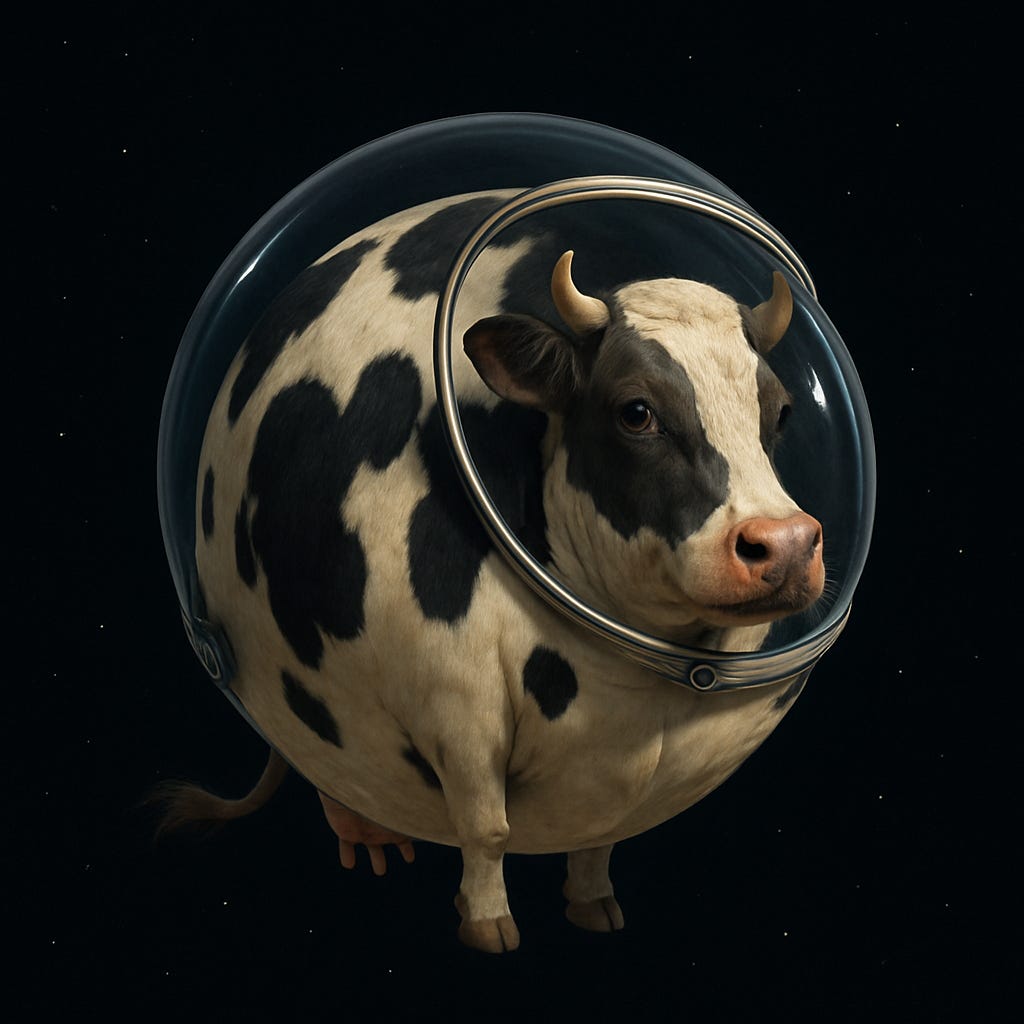
A spherical cow in a vacuum. I gave her a space suit so she wouldn’t suffocate.
Debugging: If you know what the answer should look like, simplifying can help isolate the problem.
When hunting for a leak in a pressurized system, split the system in half and test each section separately to see which holds pressure. Once you identify the problematic half, split that section again and repeat until you've narrowed down the location enough that the leak becomes obvious. This also works for locating the source of a mysterious noise.
You can use the same process when your computer code doesn’t give the result you expect. Break it into simple chunks where you can predict the output, then compare your predictions against the actual results. Test one piece at a time until you isolate the problem.
2. Maximize your signal to noise ratio
Signal to noise ratio is a concept in electrical engineering that’s incredibly useful for communication. The “signal” is your core message, the important information you’re trying to convey. “Noise” is everything else that gets in the way of that message being conveyed clearly. If you’re talking to someone in a crowded restaurant, then your words are the signal and the background chatter is the noise. If you’re sending an email, then your key points are the signal and typos, jargon, and rambling paragraphs act as noise. To communicate effectively, you need to boost your signal by making your main points clearer and more prominent, while reducing noise by eliminating distractions and unnecessary elements. The better your signal-to-noise ratio, the more likely your audience will understand your message.
Presentations: eliminate visual clutter. Animations and colored backgrounds are noise, so you should avoid them. Images and videos have higher signal value than text. I’ve heard that PowerPoint slides should only have seven words per bullet point; I don't usually manage to cut the text down that much, but it's a goal to strive for.
Academic writing: Use visuals (charts, graphs, and images) to tell your story. Make your key findings visually obvious instead of burying them in a wall of text. In my non-academic writing, italics and bullet points seem to work well to highlight important points.
Job applications: Cut through the noise by making your qualifications immediately obvious. Lead with your strongest accomplishments. Recruiters may only spend a few seconds scanning through your resume, so your signal needs to be powerful enough to survive that short attention span.
Social media: Clean up your social media feed by blocking or unfollowing accounts that post clickbait. You only have so much attention, so focus it on the content you genuinely care about.

Here’s an example of a very poor signal to noise ratio. The signal (that the bridge is out) is completely drowned out by the noise about the sign having sharp edges.
3. Use a variety of mental models
For my PhD I was co-advised by a professor in electrical engineering (Dr. Peterson) and one in chemical engineering (Dr. Tree). Each tended to look at problems through the lens of their own field, and so getting both sets of perspectives gave me a richer toolkit for tackling the problems I was working on. That experience reinforced how powerful it is to have different mental models available for approaching and understanding different problems. Some useful concepts and mental models I absorbed during grad school include:
Inversion: Turn the problem upside down. Instead of asking how to make things better, ask yourself how to make things worse, then do the opposite.
Narrative: People are more likely to be interested in the things you tell them if you can make a good story out of it. This is just as true in science. Scientific writing needs to set up a mystery that needs to be solved, explain your plan of attack and why it’s the best one possible, show how your data give a compelling answer to the mystery, and explain the implications of this new discovery.
Opportunity cost: Every action has a cost. Part of that cost is the time and energy that you could be dedicating to something else. If you spend an hour waiting in line for free concert tickets, then you can’t spend that hour watering your plants, playing with your dog, or learning to unicycle. So the tickets aren’t really free, they actually cost one hour of your life.
Feedback loops: Every time you perform an action, you can compare that result against your expectations to know if your strategy is working or not. This comparison gives you a feedback signal that helps you know what to change and what to keep the same. If you try a new study method and your scores go down, then you shouldn’t keep using it. If you write a blog post and it gets a lot of likes, you should write more like it. The faster and clearer the feedback, the quicker you can refine your strategy.
I also have a big list of links about mental models here.
4. Be systematic
My last couple weeks of grad school were focused on organizing and backing up data for future students to use. It was a big project, but it made sense that my advisors would require this so that the information didn’t get lost when I moved on. Here are some tips on developing an organization system that will save you time in the long run.
Keep your computer organized. Develop a consistent system for organizing files and stick to it, so that you don’t have to waste time chasing down important documents later on. On my computer I use a simple folder structure with main folders for different projects and subfolders as needed. Each project also has a "trash" subfolder for files I probably won't need again but am too nervous to delete permanently. I'm also working on using more descriptive filenames to make them easier to find later.
Back up everything. Save and back up your work often, it will save you from heartache when your computer crashes. At my work we use Microsoft OneDrive to automatically back up everything to the cloud. On my home computer I do most of my writing on Google Docs, so it gets saved to the cloud automatically. I’m trying to remember to manually back up the notes on my phone at least once a month, but I’m starting to think it’s worth switching to a different app that will back them up automatically.
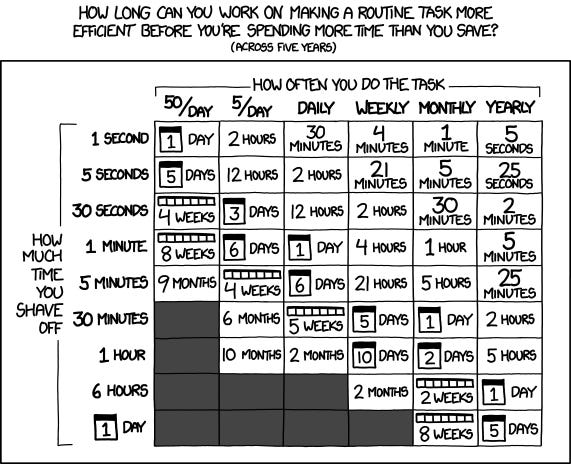
From https://xkcd.com/1205/ . If you can make a daily task 5 minutes more efficient, then (over the course of 5 years) that adds up to 6 days of your life you saved not having to do that task!
5. Master the art of collaboration
Working with others amplifies what you can achieve, lets you attack bigger problems, gives you more opportunities for career growth, and can make your job more fun.
Build genuine relationships. Good collaboration comes from trust and mutual respect, which develop over time. The strongest professional relationships often feel more like friendships: they’re built on shared experiences, mutual support, and authentic care for each other's success.
Networking is really important! Before you can collaborate with someone, you need to have them in your social/professional network. This is something that really doesn't come naturally to me, so maybe take my advice with a grain of salt. But in my view, there are three main steps of how to build your network: 1. Go to events where you’ll meet relevant people. 2. Go up to people and talk to them. 3. Hold enough of a conversation to make a meaningful connection. Each of these three steps is a learnable skill, though they come more naturally to some people than others. I think there might also be other steps that I'm missing, like doing research beforehand and reaching out to the people afterward, but these three steps are a good place to start.
Share your work publicly. Part of the scientific method is sharing your results, which in academia means publishing papers. Publishing creates a permanent record of your contribution and makes your work discoverable by potential collaborators. In non-academic contexts this might mean giving talks, writing about your work online, or even sharing pictures on social media.
Conclusion
Becoming a top performer in thinking-intensive fields requires mastering skills that aren't always obvious or well-documented. That's why, like athletes studying game footage, I've made a deliberate effort to analyze what I learned during my PhD, particularly the techniques I absorbed from observing my advisors in action. While some lessons were technical and engineering-specific, many were broader thinking strategies that work for a broad range of problems. Most of these lessons weren't explicitly taught; I had to glean them from conversations, observations, and my own reflection on the approaches my mentors took.
The goal of being a grad student isn't to become a carbon copy of your mentors, but to internalize their best practices and adapt them to your own style and challenges. So if you ever have the opportunity to work closely with exceptional thinkers, treasure it. Most people focus on learning what they know, but the more valuable lesson is in how they think. Going back to the film analogy, you only get a limited time to watch them before you graduate and lose that front-row seat to their thinking, so make every second count.
Many economists have a personal blog. It's not a video of them working, but it's still a way to see the way they think. This is rarer in other scientific fields; I think maybe having a personal blog is seen as unprofessional. Which is a huge shame, because it means we’re missing out on valuable insights about how some of the smartest people in the world think and solve problems.
Great thoughts. Learned a ton from Doug on code development and good habits that I apply daily!