
“For every complex problem there is an answer that is clear, simple, and wrong.”
Unintended consequences suck. Yet they happen whether we like it or not.
In 1935, cane toads were introduced to Australia to control a beetle that was eating the sugarcane. They ate almost nothing they were supposed to, bred explosively, and became a toxic invasive species that will eat an entire bowl of dog food and then lay in the dish while the hungry dog watches.
In the 1960s, Soviet planners redirected the water from two rivers to irrigate their cotton fields. Because of this, the Aral Sea that was fed by those rivers lost over 80% of its volume, local fishing economies collapsed, and the exposed seabed now kicks up toxic dust storms.
In Vietnam, the French colonial administration offered a bounty paid for rat tails. Rather than exterminate the rats, entrepreneurial hunters would cut the tails off and release the rats to keep breeding. Health inspectors even discovered farming operations dedicated to breeding rats.
Each one of these interventions was clear, simple, and seemed like it should have worked. And yet they all made things worse. The problem was that the people in charge were confident that they understood a system well enough to redesign one piece of it without disturbing the rest, and they were wrong.
This confidence, and its repeated failure, is the starting point for the concept of philosophical conservatism: the view that we should be wary of trying to edit a complex system that we don’t fully understand. In politics, this shows up as a preference for gradual, reversible change over sweeping reform. In science, it shows up as skepticism toward claims that overturn established theories without equally strong evidence. More generally, it’s an instinct to ask what purpose an existing system or tradition might be serving before trying to change it. This instinct is very good at keeping bad ideas from becoming disasters, and I think it’s an idea that’s worth taking some time to think about.
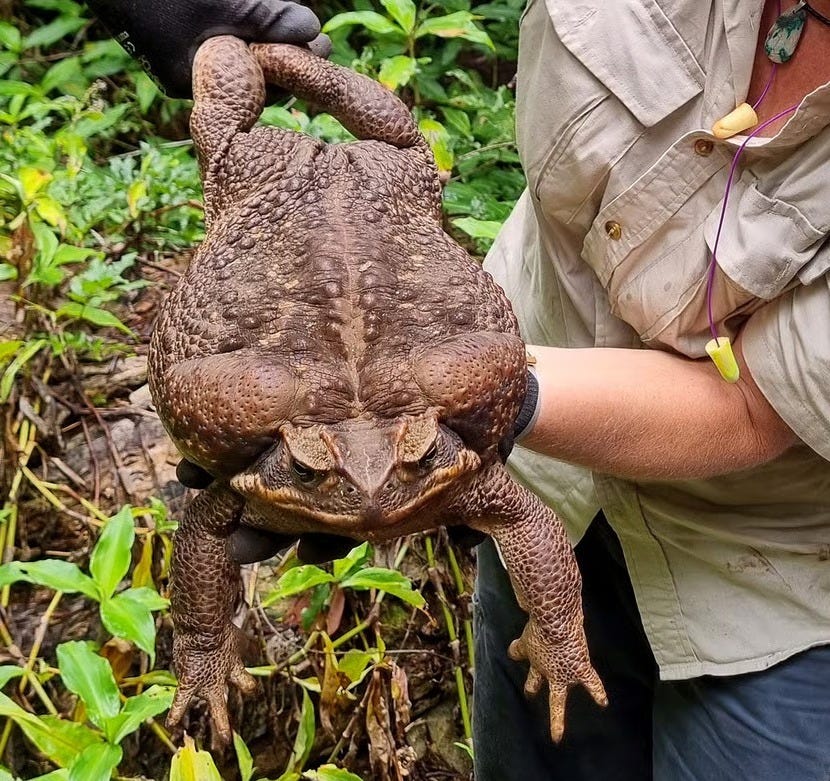
“Toadzilla” is the largest cane toad on record, weighing 2.7 kg (5.9 lbs) and discovered in Queensland, Australia.
Chesterton’s fence
Thousands of years ago, people in what’s now southern Mexico and Central America developed a method of preparing corn (maize) by soaking it in water mixed with either wood ash or burnt seashells before cooking and eating it, a process called nixtamalization. When the Europeans came and exported corn back to Europe, they left this culinary practice behind. (Who has time to make burnt seashells water to soak the corn in before cooking it? Not me!) This turned out to be a mistake, because nixtamalization chemically alters the corn to release vitamins that are otherwise inaccessible. Europeans who made corn their main food source without nixtamalizing it began to suffer malnutrition without understanding why. This later became a huge problem in the American South, where over 3 million Americans became malnourished from this deficiency (it was Vitamin B3), and over 100,000 died before they figured out how to prevent it. Sometimes traditions are there for a reason, and they shouldn’t be discarded just because we don’t understand them.

Corn kernels that have been soaked in an alkali solution are called hominy.
Contrast this with another story. In a common modern folk tale, a girl is helping her mother cook a pot roast and asks “why do we have to cut the ends off the pot roast before putting it in the pan?” The mother says “that’s how grandma always did it,” but doesn’t know the reason for it, so they go and ask grandma “why do we have to cut the ends off the pot roast before putting it in the pan?”. Grandma replies “When I used to cook it, the pot roast was bigger than the pan I had at the time, so I had to cut off the ends to make it fit!” The original reason for cutting off the ends didn’t exist anymore, so it would be silly to keep doing it.
Some things are like soaking corn in seashell water, where getting rid of a tradition causes a disaster. Other things are like the pot roast, where the tradition no longer serves any purpose and would be silly to continue. But if you want to know which is which, you need to understand why the tradition exists. This idea is known as Chesterton’s fence, based on the saying “Don’t try to remove a fence until you know why it was put up in the first place”.
If you tear down a fence without understanding why it was built, you might end up falling into a ditch or being chased by a bull. On the other hand, if you go through the effort of asking why it was built, one of three things might happen:
You learn that the reason for the fence no longer exists and it’s safe to tear it down (like the pot roast example).
You learn that there’s a good reason to have a fence there, and you decide that it’s best to keep it there to avoid a disaster (like the corn example).1
The reason for having a fence there still exists, but the benefits of removing it outweigh the benefits of keeping it up.
An example of the third case is library late fees. My city’s library used to charge fines on overdue books. These fines served an important purpose of encouraging people to return books on time. However, recent research has shown that late fees disproportionately discourage lower-income people from using the library. While the original reason for having late fees still exists, my city’s library decided that the harms outweigh the benefits, and so they decided to eliminate late fees completely.
Before we try to change a social norm, institution, tradition, or ecosystem, we should understand why it was created in the first place and what purpose it’s serving. (Is it unsoaked corn, a pot roast, or a library late fee?) Then, armed with that information, we can make an informed decision about if we should change it or leave it alone.
When should you not be conservative?
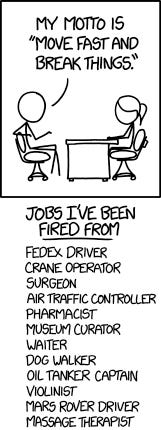
“Move fast and break things”
-Mark Zuckerberg
Last year I got to listen to a speech by Nobel laureate Omar Yaghi at the American Chemical Society conference. He talked about using AI to accelerate chemistry research to solve global problems like climate change. Afterwards, in a question and answer session, someone asked if we should be concerned about AI energy and water use. His response was “I am not a fan of conservative thinking,” meaning that the possibility of dramatically accelerating the discovery of new climate technology was too important to let AI’s current environmental costs keep us from pursuing it.
In the case of AI and scientific research, I think Yaghi was absolutely right; the benefits of developing better climate technology are thousands of times more impactful than the current costs of using AI. But I do think there are some situations where conservative thinking is warranted.
In general, we should be conservative when:
We don’t fully understand the consequences of an action.
Failure would be dangerous, slow to detect, or hard to reverse.
Any negative effects of the action will fall primarily on other people.
Conservative thinking is less appropriate when:
The idea can easily be tested on a small scale first.
Failure would be detected quickly and can be reversed.
The cost of inaction is higher than the risk of action.
This is why tech bros can get away with having “move fast and break things” as their motto: a bad software update can be rolled back in an afternoon, failures usually surface within days, and in a highly competitive industry, moving too slowly is more costly than making an occasional mistake. However, if agricultural officials decide to “move fast and break things”, then that’s how we get cane toads eating dog food in Australia.
The case for conservatism also gets weaker when the existing system is already causing or allowing serious harm. Every year, malaria kills half a million people, most of them children under five in Africa. An organization called Target Malaria, funded by the Gates foundation, wants to release genetically modified mosquitoes engineered to collapse local malaria mosquito populations. It’s exactly the kind of intervention that should make a conservative uneasy: nobody can fully model what removing a species will do to an ecosystem, and a self-propagating genetic change is hard to reverse once released. But it also satisfies the second list: the project spent years in small, contained field trials, with regulators monitoring the work and local communities involved, before any wider rollout. In August 2025, Burkina Faso’s government shut it down anyway, even though its own regulators had approved it just weeks earlier. The reversal was driven partly by the military government’s desire to push back against Western influence and partly by social media claims that the project was intended to weaponize mosquitoes to spread disease and sterilize people. When hundreds of thousands of people are dying every year, refusing a well-tested solution because of who funded it is hard to justify. (Can you tell I’m still upset about this?)
I got this image from Target Malaria’s LinkedIn.
There’s always a balance between moving so fast that you don’t notice what you’re breaking and moving so slowly that you let a failing system continue to cause unnecessary harm. I think many disagreements in politics and science come from people focusing on only one side of that tradeoff: “Changing things too quickly will cause a disaster!” versus “But people are suffering now!” The better approach is to understand the possible consequences, test changes on a small scale when possible, and then follow the evidence. That's the sweet spot: cautious enough to avoid preventable disasters, but not so cautious that we allow avoidable suffering to continue indefinitely.
Conclusion
"Move slow and don't break things."
-Mark McDonald
There are many common sayings that encourage us to be conservative, like “If it ain’t broke, don’t fix it”, “Look before you leap”, and “Measure twice, cut once”. Philosophical conservatism isn’t owned by either political party. A progressive defending democratic norms could be more conservative than someone on the political right calling for sweeping change. It’s about being cautious of changing too much too quickly, understanding why things are the way they are, and respecting the accumulated wisdom that exists in our institutions and traditions.
Some areas, like technology and some fields of science, do well with a motto of “move fast and break things”. But when we’re dealing with systems we don’t fully understand and where changes are hard to reverse, a motto of “move slow and don’t break things” is usually the wiser approach.
Nixtamalization isn’t a perfect example here, because the practice evolved without people really understanding the nutritional benefits, and they weren’t fully understood until much later. So sometimes, even if you can’t identify a good reason to have a fence there, you should err on the side of “if it ain’t broke, don’t fix it”, unless there’s a compelling reason to get rid of it. And, if there is a compelling reason, stay on the lookout for unintended consequences after you make the change.
Good writing! Thought provoking