Unplugging the hedonic treadmill
The hedonic treadmill makes you adapt to improvements in your life until you take them for granted. Here’s my first attempt to stop that.

Psychologists have noticed that people quickly adapt to improvements in their life and soon start taking them for granted, which is sometimes called the hedonic treadmill. The word “hedonic” comes from Greek and refers to happiness, and the word “treadmill” refers to moving forward without actually getting anywhere. This is upsetting, because I don’t want improvements in my life to fade into the background, I want them to make me happier!
I’ve been trying to think of ways to keep the good things in my life from fading into the background, and the insight came when I had the thought, “If you think comparison is the thief of joy, then you’re doing it wrong.” Comparison is only the thief of joy if you compare to people who you perceive as better off than you. Which leads to my new idea: instead of comparing yourself to other people, compare against a past version of yourself that you perceive as worse off. Then be grateful you aren’t in that situation any more. I’ve been using this type of comparison for the last couple weeks to make myself feel more content and happy with what I have.
Ordinary life is really nice
Here are a couple examples of this type of comparison (this is me talking to myself):
I feel pleasantly cool in this air conditioned room. Remember when I lived in Mexico and was sweating constantly because almost no buildings had air conditioning? I’m glad I’m not there right now.
My shoes feel comfortable on my feet. Remember when I went on an excursion at Scout camp, but I left my shoes in the canoe and had to walk over really spiky pine needles? I’m glad I don’t have to walk on spiky pine needles in my bare feet right now.
I start to feel bored. Remember in college when I was rushing to finish my homework before the deadline? I’m grateful for the luxury of feeling bored right now.
I’ve started using these kinds of comparisons (I call them “comparison memories”) as a sort of gratitude system. I think of a memory that contrasts sharply with what I’m currently experiencing, that I can look back on and laugh about. This gives a double dose of gratitude, once from “I’ve had some exciting experiences!” and another from “I’m glad I’m not experiencing that right now!”1
The hedonic treadmill is haunted
Comparing your current circumstances to a memory of when you weren’t as comfortable is meant to recalibrate your expectations so that the improvements in your life don’t fade into the background. I think of this as “unplugging the hedonic treadmill”.2 It helps me remember how good I have it just sitting on the couch in an air conditioned house while wearing comfortable shoes and not having anything urgent to do.
Sadly, the hedonic treadmill is haunted. Every time you try to turn it off, it will turn itself on again as soon as you aren’t looking. Our brains are extremely good at adapting to our circumstances. The things that once felt extraordinary eventually become ordinary, and things that used to seem like luxury become the new baseline that you compare everything else against. That’s why I’m trying to make my comparison memories idea into a habit, so I can fight back against the imaginary treadmill ghost and stop forgetting how nice my ordinary life is.
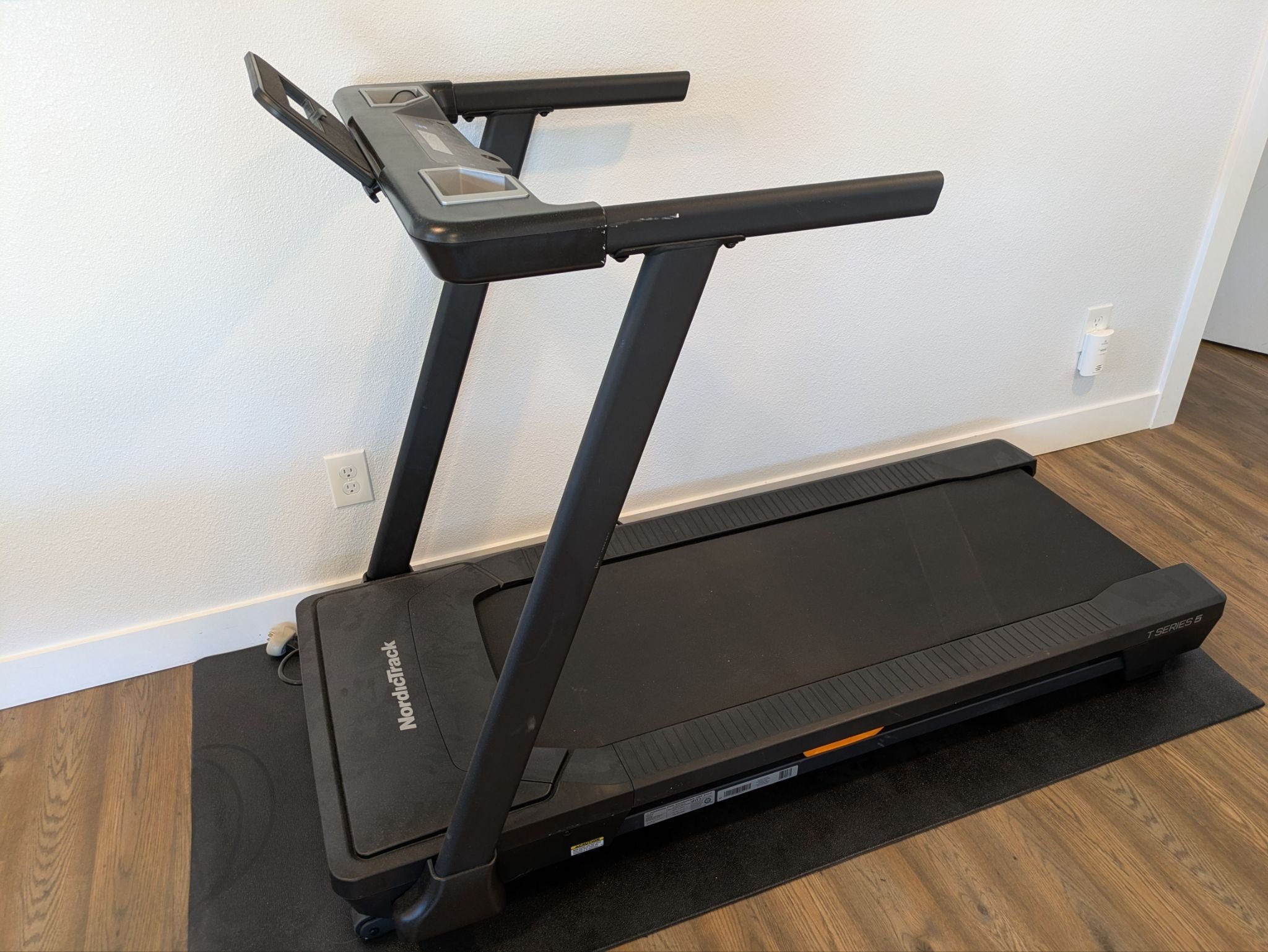
This is just a normal, non-haunted treadmill. When you turn it off, it stays off.
Comparison memories as a habit
Making comparison memories into a habit means creating triggers for the habit. So far I’ve thought of two types of triggers:
Sensations such as hunger and thirst. I notice that I’m slightly thirsty. I remember the time I went hiking to a lake in Utah without a water bottle and felt like I was dying of thirst. This makes me grateful for the drinking fountain that’s just down the hall from my office at work.
Things that annoy me. When the internet is being slow, I remember that in the early days of dial-up internet it would often take 30-60 seconds just to connect to the internet.3 Thinking about that helps me remember how much progress the world’s technology has had since then and helps me be less annoyed at my occasional experiences with slow internet.
Sensation triggers work well because they happen frequently and are hard to avoid. This helps me be more grateful for everyday things so I don’t take them for granted. The “things that annoy me” trigger is useful because when I’m feeling annoyed by a minor inconvenience is also when it benefits me most to put things in perspective and feel grateful for the things I have.
Last week the air conditioning in my house broke. It’s fixed now, but it briefly got up to 83°F while I was trying to sleep. I thought to myself, “in the winter I’m going to be cold. I’m going take this memory of being hot and sweaty and store it in a box so it can warm me up the next time I need it.” That made me feel happier. I still didn’t sleep very well though.
Conclusion
When you compare yourself to other people (or even a past version of yourself) who you perceive as more successful, it can make you feel like you need to keep up with them, which can lead to jealousy and “keeping up with the Joneses”, and which is where we get the phrase “comparison is the thief of joy”. When you’re constantly making these types of comparisons, it makes the hedonic treadmill run so that you never grow content with what you have. But if instead you compare yourself to a past version of you who was worse off in some way, it lets you see how much progress you’ve made. I’m using this idea to build a gratitude system by making a habit of “comparison memories”, where I think of times in my life I can look back on and laugh about, and then feel grateful I’m not in that situation any more.
Gratitude is scientifically shown to improve your mood. So far, using these comparison memories as a way to remind myself to be grateful for what I have over the last week or so really has improved my mood. I recommend it.
So far it’s been easy to think of comparison memories, but if I ever struggle then I bet comparing to other people’s memories or to characters in a novel would work too.
It’s also very similar to a Stoic practice called negative visualization, where you deliberately imagine losing things you currently have in order to appreciate them more. For example, a Stoic might imagine their spouse died, their house burned down, and they lost their eyesight, and then feel grateful that none of those things happened. But that’s kind of depressing, so in my version you think of a memory you can laugh about but that still highlights how good you have it.
I’m not sure if that’s an actual memory I have or if I’m just remembering other people talking about it. I would have been very young.
Glad you got your air conditioner fixed!